![true-impact-logo-color.svg]](https://support.trueimpact.com/hubfs/true-impact-logo-color.svg)
Social Impact Report Sections:
- Report Overview
- Donor Impact Receipt
- Impact Model
- Beneficiaries
- Budget
- Lessons Learned & Success Story (Final Reports Only)
Report Overview
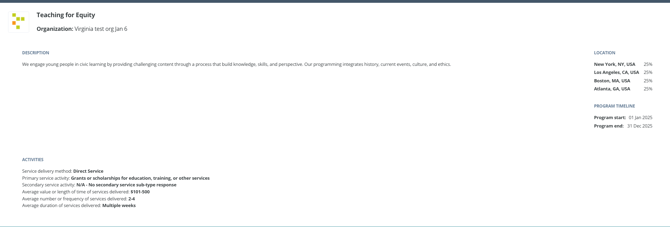
At the top of the report, you'll find the program's title, the organization's name, and a description giving background on what the program entails.
- Location: shown on the right-hand side, along with the percentage of the program taking place in each listed location.
- Timeline: the program's start and end dates.
- Activities. The Activities section describes how the program's services are delivered, including how often they're delivered, the value of the goods being delivered, and how long it takes to happen.
Donor Impact Receipt
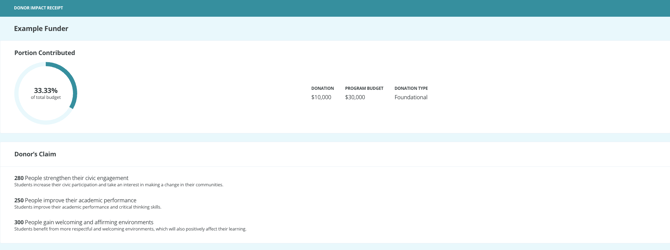
This section tells you exactly what you can claim as your impact for this report.
- Portion contributed: your investment as a percentage of the program's total budget, along with the donation amount and the program's margins.
- Investment classification: how the grantee has classified your investment.
- Significant: your claim is proportional to what you contributed to the program (you funded 30% of the total program budget, then you claim 30% of all impacts).
- Foundational: you can claim 100% of the program's impacts. You are either funding the entire program's budget, or your funding was essential to secure additional funding that made the program possible.
Impact Model
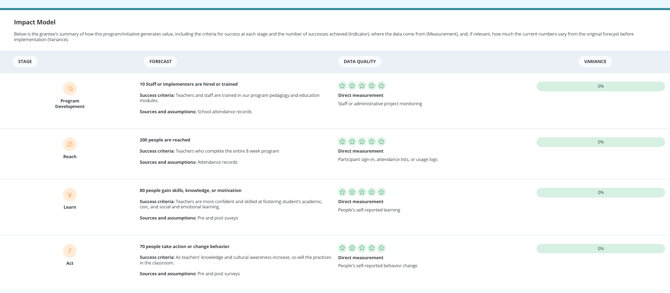
The program's impact model (also known as logic model or theory of change) is a step-by-step illustration of a program creates value. At True Impact, our impact models are a refined version of logic models, focused on the end outcomes.
When an organization builds a model, they will select indicators from True Impact's standard library. These are pre-defined outcome measures organized by cause area and stage.
We break inputs, outputs, and outcomes into a five stage impact model, which can be seen below.
|
|
Impact Model Stage |
What it Captures |
|
|
Program Development Inputs |
The number of improvements in infrastructure, operating practices, systems, or staff used to deliver a program’s services. (optional) |
|
|
Reach Outputs |
The number of people served by the program. |
|
|
Learn Interim Outcomes |
The number of people who then gain the skills, knowledge, motivation, or access to resources that will enable them to achieve success. (optional) |
|
|
Act Interim Outcomes |
The number of people who then take action or change behavior in order to achieve success. (optional) |
|
|
Succeed (Social Impacts) Outcomes |
The number of people who improve their well-being by achieving the program's end goal. |


Reach and Succeed are required. Learn, Act, and Program Development are optional. Most models work well starting with just Reach and Succeed.
What are the terms in each of the indicators of an impact model?
- Success Criteria: how the grantee has defined that indicator and what it means to them.
- Sources/Assumptions: how the grantee is tracking that indicator (e.g., surveys, studies, participant observation).
- Data Quality: classified as Direct Measurement, Estimate, or Guess.
- Variance (final/finalized reports only): the percentage difference between the initial forecasted number and the final number.
Beneficiaries
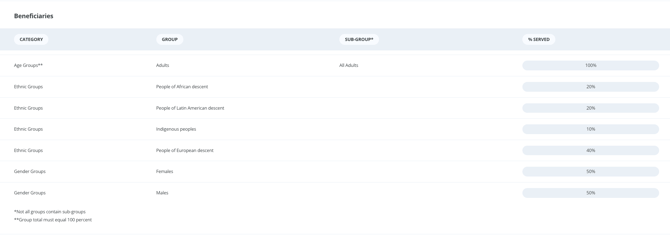
This section details whose lives are improved as a result of the program.The nonprofit determines which demographic categories to include and reports on the percentages based on direct measurements or estimates from secondary data. True Impact encourages nonprofits to include socioeconomic status, race/ethnicity, gender, and age categories in their beneficiary section.
Budget
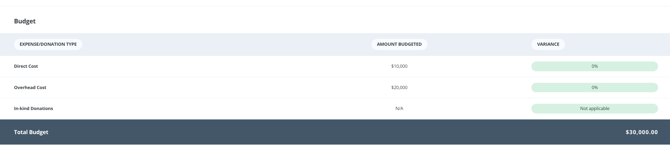
The final section of a nonprofit's Social Impact Report is the budget section. This section provides a high-level summary of how much it costs the program to improve the lives of their beneficiaries. The budget section includes direct costs and indirect costs, brief notes explaining each, and a total budget amount. You can learn more about how a nonprofit completes the budget section here (jump to section 9. Budget).
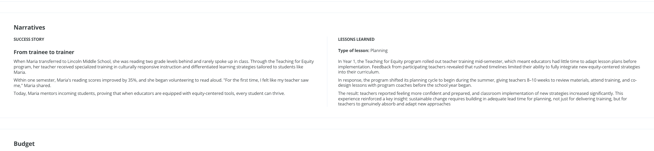
Lessons Learned & Success Story (Final Reports Only)
On final reports, you will also see a section for lessons learned and a success story for the program.